draft
- 5 whys
- second order thinking
- dialing the problem to its roots through questioning with use of first principles reasoning
Root Cause Analysis: Techniques & Frameworks
outline
- preface, what root cause gives you - underlying truth, pattern, incentives
- iterative questioning: tate, mask. 5whys, first pr, inversion, occams, 5 hows socratic
- systems & structural thinking
Root cause & Decomposition techniques are valuable because they move you beyond the surface level of understanding the world. They help you to see the decisions, the world objectives, incentives, and drives that are pushed towards masses by government by people by those who are in beneficial situation because of those pushed agendas. It helps you to decompose the essential fundamental truth out of things.
I’ll lay down few ways of approacing them for myself. I don’t necesserily use all of them.
Iterative Questioning
Questioning is one of the main methods of reaching the underlying truth. And I’ve seen this pattern of questioning and obtaining the deep knowledge of things very often, especially in Andrew Tate and in Elon Musk. But Andrew Tate does this pretty much every time. And he has lots of theories. He has lots of ideas and you can see man he you can see how often he come up with some assumption or idea.
And almost every time it makes sense because he gives an insight on how Matrix works, how taxes works, how power dynamics works, how social dynamics works and the pattern that I noticed why does he uh point such things that accurately is because he questions a lot. He does this decomposition by questioning. Why does it work like that? Who benefits from this? Why is it happening? Who’s behind this? And all this questioning that he does gives him this understanding of things.
Most people don’t have the drive nor ability anymore to go deeper in your thinking or Do your own thinking. And it’s so easy to get these sort of insights on your own, without having someone to tell you those. It just takes thinking, which is a finite resource that we spend on crap content every day: You are a result of your yesterday’s actions, inputs and intake choices. So who you are today is who you were yesterday.
we need to be reminded more than we need to be taught and that tells me that you can have just as much insights and knowledge of things like Andrew Tate and Elon Musk both have.
Questionings techniques
- 5 WHY’s: Repeatedly asking ‘why?’ to drill down from a symptom to a root cause.
- 5 HOW’s: The inverse. Instead of asking why a problem exists, ask how it could be systematically prevented or solved. Shifts focus to actionable leverage points.
- Socratic questioning:
- First principles thinking: Break down a complex problem into its most fundamental, undeniable truth. Rebuild the solution from the ground up, from scratch addressing only the fundamental details and components.
- Inversion: the inversive questioning of a problem. End → Start.
- Don't ask: How to start a thematic channel and sell digital products there. Build a leverage
- Instead ask: how to postpone your inevitable ig channel success, and how to keep away yourself from starting this channel? What can you do to keep it just a wet fucking dream of yours? What shouldn’t you do
- answers:
- not trying to post at least one video using an index card and mat.
- not dissecting the lessons from that guy i followed in tg. about thematic channels.
- not developing a brand strategy on canvas, not laying down the theme, logo, naming, visuals, tools, description.
- How to choose the theme and The solution that eases someone’s pain when they open Instagram. One way is to just analyze your patterns and to discern what people are reacting to, what they respond to, because it’s all about patterns and what people are drawn to. We seek pleasure, entertainment, motivation, and advice on internet. So these are the vector attacks of how to choose the correct theme and topic.
- answers:
- second-order thinking: go beyond the first outcome or cause. Map the consequences of the consequences. Ask: if this happens then what? And then what? What might occur?
Systems & Structural Thinking
- The Iceberg Model (Systems Thinking):
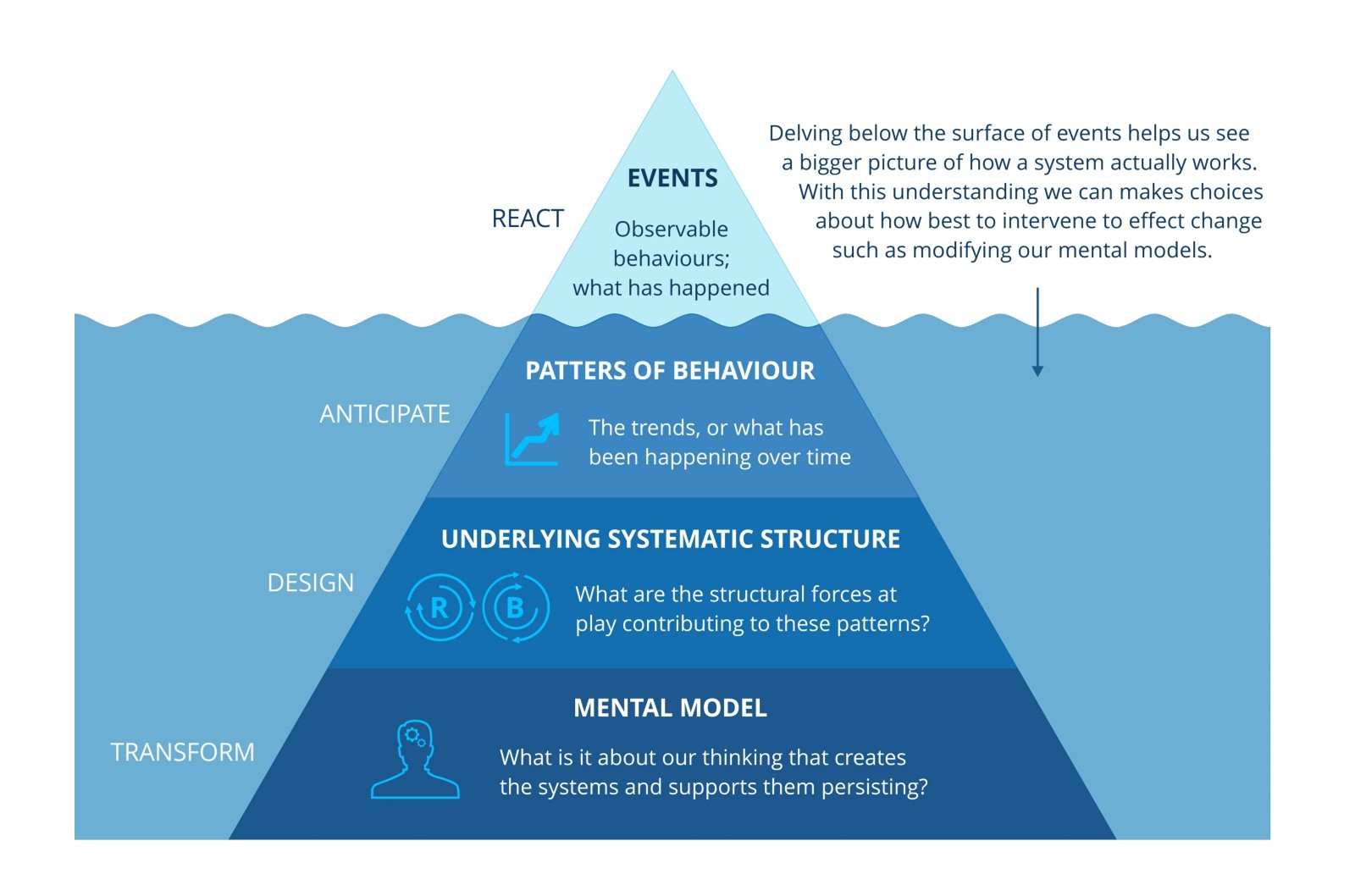
- Events (tip): What happened? (The symptom)
- Patterns: What trends or repeated behaviors lead to these events?
- Structures: What systems, rules, or relationships generate the patterns? (e.g., incentives, feedback loops, information flows).
- Mental Models: What underlying beliefs, values, or paradigms justify the structures? (The deepest root).
- Application: Don’t stop at “pattern” (e.g., “we always have Q4 delays”). Ask: What structure creates this pattern? (e.g., “annual budget cycle with last-minute approvals”). Then: What mental model supports that structure? (e.g., “spending must be justified annually, not continuously”).
- Pareto Analysis (80/20 Rule): Identifies the vital few causes (often 20%) that lead to the trivial many problems (80%). Focuses root cause efforts on the highest-impact factors.